
Available by Dani Grange in Ilkley, West Yorkshire
Who Can Diagnose a Tongue-Tie?
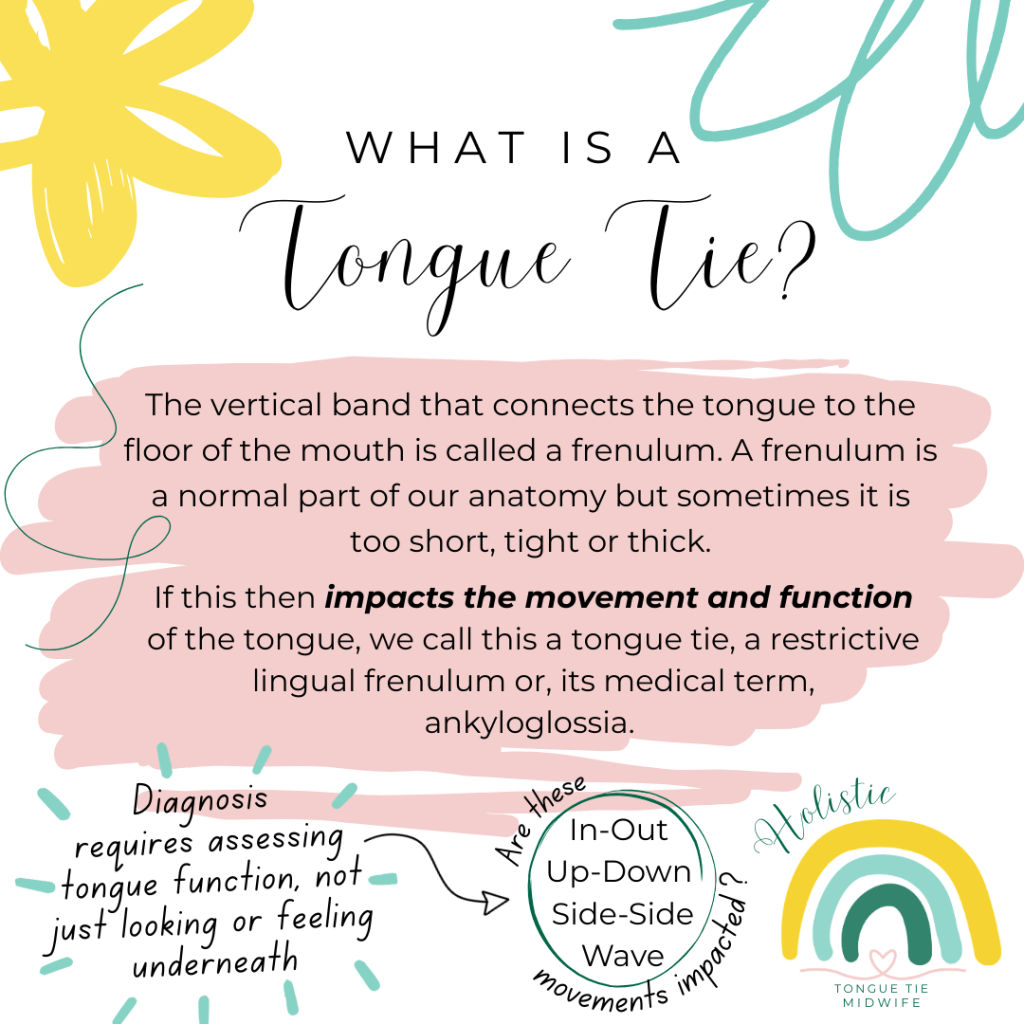
It requires specialist training to correctly diagnose a restrictive tongue tie, which involves assessing the movement and function of the tongue through oral-motor exercises, can cannot be done by just looking or feeling under the tongue.
Most midwives, doctors, breastfeeding supporters etc. will not know how to correctly identify a tongue tie unless it is a particularly obvious one at, or near, the tip of the tongue.
If you have been told by hospital staff that your baby doesn’t have a tongue tie, or has ‘a little bit of a tongue tie’, but you and/or your baby are experiencing any of the symptoms listed below, then please reach out for help – you know your baby best.
Scroll down to see baby tongue tie symptoms as well as tongue tie symptoms for mums.
Some NHS Trusts won’t refer tongue tied babies for treatment if they are putting on weight or are taking any bottles – even if those bottles were introduced due to breastfeeding difficulties related to the tongue tie in the first place!
This approach doesn’t take into account other important factors such as:
- Mental Health and Sustainability
- both parents and babies are usually compensating at the expense of their overall wellbeing
- Quality of life
- for the baby and their parents due to impacts of poor feeding technique – can be from breast or bottle
- Developmental Impacts
- relating to oral/dental health, digestion (including reflux and colic symptoms), potential future issues with weaning and/or speech development, airway health and sleep quality (from mouth breathing)
Dani is an experienced Registered Midwife, Tongue Tie Practitioner, and member of
The Association of Tongue Tie Practitioners (ATP).

Fully insured Tongue Tie Practitioner. Clinics held at CQC Registered Ilkley Dental Studio Ltd.
What happens at a
Tongue Tie Appointment?
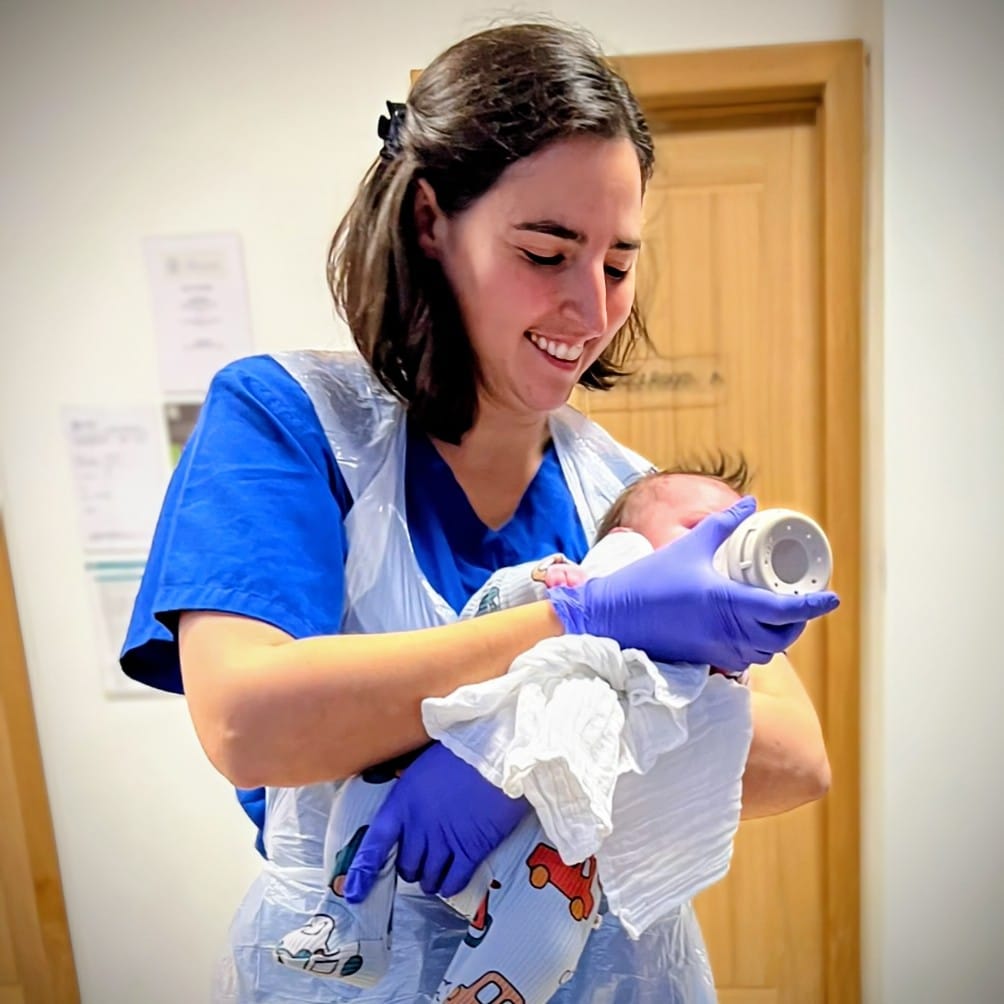
Appointments are around 60-90 minutes which is longer than most other tongue tie assessment appointments, as I prioritise time to ensure robust and individualised feeding support is included during your appointment.
The appointment includes feeding history and assessment (if required), a full tongue function and oral assessment which will be discussed with you, alongside the benefits and risks of tongue tie release (frenulotomy, also known as frenotomy).
We will discuss your options together and frenulotomy will be performed during the same appointment with your consent, if it is required and safe to do so.
Someone will be required to hold your baby’s head (but doesn’t have to look), so please be mindful of bringing someone with you if you do not feel able to do this yourself.
If the procedure was not performed, you will be given in depth feeding support and personalised advice tailored to you and your baby’s needs, circumstances and wishes.
You will be given detailed feeding support after the procedure, advice on aftercare for your baby, and exercises you can do to build strength and help them to learn how to use their tongue with it’s new found freedom!
Aftercare via messaging and/or phone calls is also included in the price of the appointment.
How to prepare for your appointment
Pain Relief
Not all babies require pain relief after frenulotomy but I recommend having some at home ready in the event that you feel your baby needs it in the day or two after the procedure. Having some easy meals planned for a couple of days will also make life easier for yourself!
For babies under 8 weeks, I recommend contacting your GP prior to the appointment to ask them for the correct dosage of liquid paracetamol for your baby based on their weight. I’m sure you will thank your past self for having already done this beforehand! If needed, you can call 111 and request a dosage from an out of hours GP.
Expectations
Release of the tongue tie is not usually a quick fix and it will likely take time for your baby to adjust. This not only involves learning new skills and building up muscle strength (in the tongue, face, jaw, neck etc.), but they also have to unlearn all the coping strategies they’ve developed before they were born and that they have come to rely on to feed until now. Please expect there to be a transition period where there will be ups and downs, this is normal and expected.
To help your baby in this transition period, I recommend some form of bodywork. This is to help them with any coexisting tension they may have (which is very common), as well as any aches or pains they may develop as a result of their new workout routine. This can be with an osteopath, cranial osteopath, craniosacral therapist or chiropractor. Please make sure that they are trained in paediatrics and are experienced in working with babies. Reviews can be helpful in finding skilful providers.
What to bring
Please bring the following with you for your appointment:
- Your child’s health record (red book)
- A suitable large muslin or thin blanket to swaddle your baby
- If bottle feeding with expressed breast milk or formula, please have a feed ready to use for after the procedure
- Nipple shields if you are using them
Frequently Asked Questions
Could my baby’s feeding problems be caused by a tongue-tie?
There are many reasons babies can have problems feeding and many can be resolved with optimal positioning and attachment so it is important to get good quality feeding support.
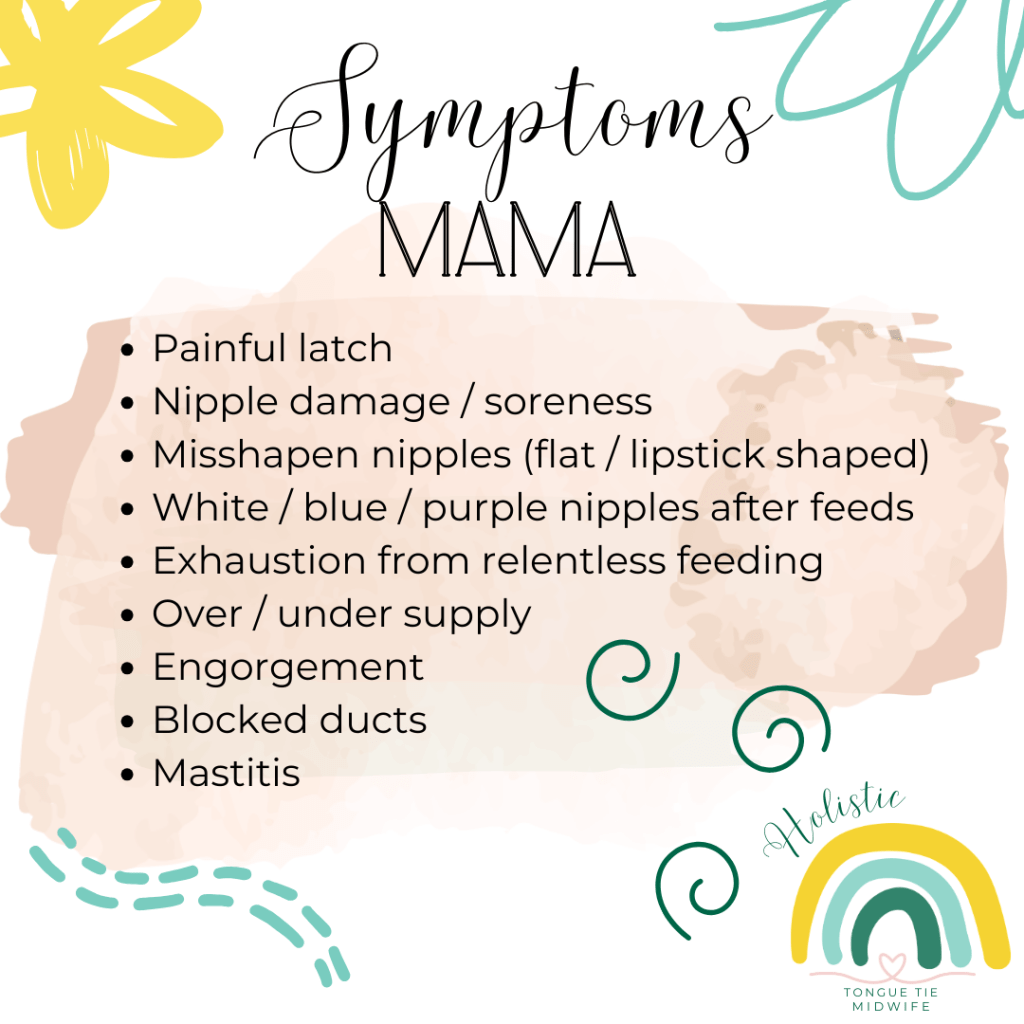
For babies who have a restrictive lingual frenulum (tongue tie), this can restrict tongue movement and make feeding, which is already a hard workout for babies, especially tiring and difficult.
This restricted movement (and often resulting high-palate too) means that an effective latch cannot either be achieved or maintained consistently which can cause symptoms such as clicking, dribbling during feeds, painful latch, tiring quickly during feeds or feeding continuously, shallow latch and slipping of the nipple/teat during feeding. Babies can also be overwhelmed by milk and can have very sensitive gag reflexes which results in gagging, choking, coughing and reflux symptoms.
We often find that tongue-tied babies can be very unsettled during and/or after feeds due to air being taken in (when clicking and dribbling) as a result of the poor/inconsistent seal when feeding.
Will a tongue-tie division (frenotomy) help my baby breastfeed better?
Not all babies who are tongue-tied will necessarily need tongue tie release so getting skilled feeding support and some form of manual therapy (cranial osteopathy, chiropractic, craniosacral therapy etc.) to help relieve any tension that may be contributing to your baby’s feeding difficulties are worthwhile first steps to explore to see if feeding can be improved prior to surgical options.
However, for babies who have impaired tongue function due to the restriction of their tongue tie, research shows that frenulotomy (i.e. frenotomy) can improve feeding in 90-95% of babies. Although there is some variation in these statistics, they are generally above 80%.
It is important to note that tongue tie surgery is not usually a quick fix and it often takes time for babies to adjust to their new tongue through both learning new skills and unlearning old coping mechanisms from before. It is essential that post-release oral-motor exercises are performed regularly to help your baby to build strength and skills with their new found freedom! Having skilled feeding support and manual therapy are also both recommended after the procedure too, to support your baby to make the most of their new abilities!
How soon after birth can a tongue-tie be released?
I can perform tongue tie releases on babies from birth until they are 12 months old.
For some babies it is very clear at birth that a tongue tie is impacting feeding but for many others it can take a little time for both baby and mum to explore and learn together to see if there are improvements before performing a procedure that may not be necessary or helpful at that stage.
Feeding is a learned skill and often symptoms improve with the right support and practice therefore a holistic assessment is important.
Is tongue-tie release painful for a baby and how long does the distress last?
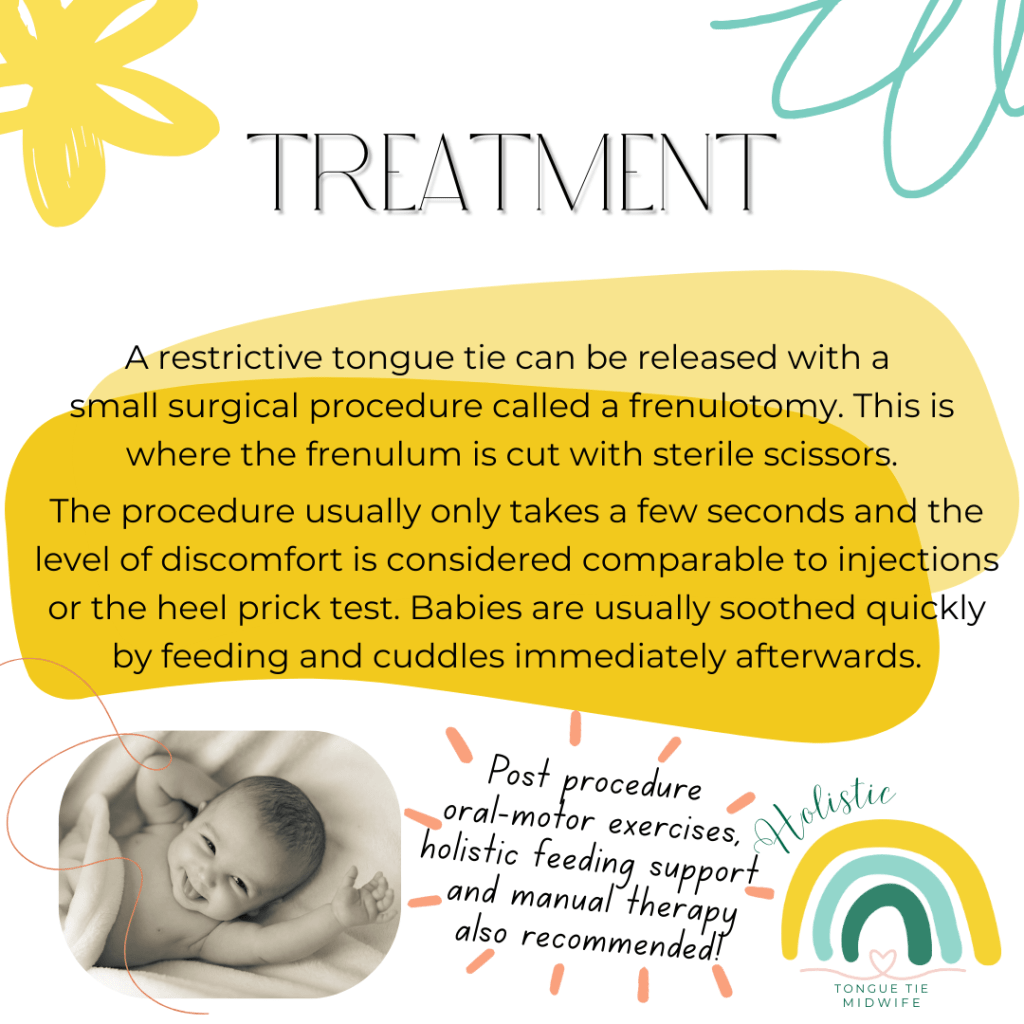
The distress babies experience is considered to be comparable to when they have injections or the heel prick test, based on how long they cry, how intensely they cry and how easily they are soothed afterwards. Babies are fed immediately after the procedure and most babies will cry until they start feeding. For some babies this is within a few seconds and for others they may require a few minutes of rocking and soothing before they will latch to feed, but they are usually calm within 5 minutes.
Local anaesthetic (numbing at the site of the procedure) is not given for the procedure because feeding afterwards is a priority and numbing around the tongue would stop a baby being able to latch and suck effectively. Sucking is important because it reduces bleeding and it also releases endorphins which are the body’s natural painkillers, so babies are usually soothed well by feeding, along with plenty of cuddles.
What does the procedure involve for a baby?
Babies are wrapped and a parent or support person with hold the baby’s head for the procedure. Sterile scissors are used to cut the frenulum. A swab soaked with frozen saline is applied to the wound to help reduce risk of bleeding and then the baby is passed immediately to a parent for feeding and cuddles.
The procedure can last anywhere from a few seconds to a few minutes depending on individual circumstances.
How quickly should I see feeding improvement after release?
Most people with experience instant relief after tongue tie release but this may only be temporary at first. Because your baby will be using their tongue in a different way, they will be using muscles in their tongue, jaw, face, neck etc. in new ways than before so they can get achy and tired. Therefore it is very normal for feeding to be up and down for the first week or so, usually with gradual improvements during and after this time. With time and practice your baby will build the strength they need to maintain the latch consistently which will help reduce their symptoms.
How long is recovery after a baby’s tongue-tie release and what aftercare is needed?
The initial wound healing takes 1-2 weeks but there is a period of rehabilitation for babies after tongue tie release which can vary in length for different babies depending on the unique struggles they are having. This could take a couple of weeks or sometimes a few weeks. Holistic support is really important to give your baby the best support possible to overcome the challenges they face.
Oral-motor exercises are taught at the assessment and are advised to be done before every feed for the first 2 days after the procedure and then continued for a few times a day for 2 weeks, or longer depending on progress.
Touching the wound is not recommended during healing as this can cause pain and aversion to things being in and around a baby’s mouth, which is not what we are aiming for.
What are the risks and complications of a baby frenotomy?
A frenotomy is considered to be a very safe procedure.
The main risk is bleeding which is 1 : 3000-5000. The risk of transfer to hospital for bleeding is 1 : 7000.
The risk of infection is 1 : 10,000.
There is a small risk of damage to the surrounding structures in the mouth but this is so rare that we do not have statistics for this.
There is a 2-4% chance of the tongue tie returning to a degree that impacts tongue function again. If this were to happen, there are scar massages that can be advised (only once the wound is fully healed) which may help to soften the scar tissue prior to exploring redivision. A second division can be performed if needed, but any further reattachment would require referral to the local ENT department for ongoing management due to risk of further scarring.
Will my baby need general anaesthetic or can it be done without?
Most babies can have the tongue tie procedure done without general anaesthetic. General anaesthetic, where you are put to sleep, is generally needed for older babies and young children where it is not safe to do the procedure whilst they are awake. This can be due to their mobility, their teeth or there are anatomical complications that would make it safer for them to be asleep during the procedure.
For most young babies, they tolerate the procedure really well and they calm down quickly with a feed and cuddles from a parent and keeping them awake gives them the benefit of feeding straight away afterwards where they often have the best feed they have ever had!
Do I need to do tongue and lip exercises after the procedure – who teaches them?
Oral-motor exercises are taught during the assessment as they are used to do the assessment so you will get a full demonstration and explanation on the day.
They are advised to be done before every feed for the first 2 days after the procedure and then continued for a few times a day for 2 weeks, or longer depending on progress.
Touching the wound is not recommended during healing as this can cause pain and aversion to things being in and around a baby’s mouth, which is not what we are aiming for.
What are the chances of re-attachment or needing a second procedure?
There is a 2-4% chance of the tongue tie returning to a degree that impacts tongue function again. If this were to happen, there are scar massages that can be advised (only once the wound is fully healed) which may help to soften the scar tissue prior to exploring redivision.
A second division can be performed if needed, but any further reattachment would require referral to the local ENT department for ongoing management due to risk of further scarring.
It is important to note that regrowth of a frenulum is normal as long as tongue function is not impaired.
Can I self-refer to a specialist tongue-tie clinic in the North West or do I need a GP/midwife referral?
Yes, you can self-refer to my specialist tongue-tie clinic in Ilkley, West Yorkshire. If you are unsure if your symptoms or your baby’s symptoms could be due to a tongue tie, then feel free to get in touch to discuss before booking an assessment.
• FEEDBACK FROM FAMILIES •
Dani performed a tongue tie division on my 6 week old daughter. She was incredibly kind, thorough and knowledgeable from the off; from when I first contacted her, in the run up to and during the procedure, right through to the support afterwards. I am so grateful for her kindness, expertise and guidance at a time when I’ve felt so vulnerable and anxious about my newborn daughter. I would highly recommend Dani.
– Sophy
Dani performed a tongue tie division on my 16 week old baby girl following her tongue tie assessment. She was extremely knowledgeable and reassuring throughout the process and offering plenty of guidance and advice which really reassured me. My baby now has so much more movement with her tongue and her reflux has really settled.
– Georgina
I know that the safety and wellbeing of your previous baby are the most important thing to you, so you will want to ensure they are in good hands with someone who truly cares. You can read more reviews about me and the care I offer on the links below.
 Holistic Tongue Tie Midwife